
Choosing the type is the first and most consequential decision in an activation. Each type carries a different instruction and a different sensory footprint, and the wrong one moves people in the wrong direction.
MassComs supports your organisation’s safety plan. It does not replace authorised instructions, trained judgement or emergency services.
Before you start
Have these ready.
- No prerequisites — this is reference reading, best done before you need it.
- 01
LOCKDOWN — secure all areas immediately
The instruction is to secure in place: lock doors, stay away from windows and glazing, stay quiet, wait. Used for an internal threat where movement increases exposure.
Lockdown and evacuate are opposites. Activating the wrong one sends people towards the thing they should be away from.
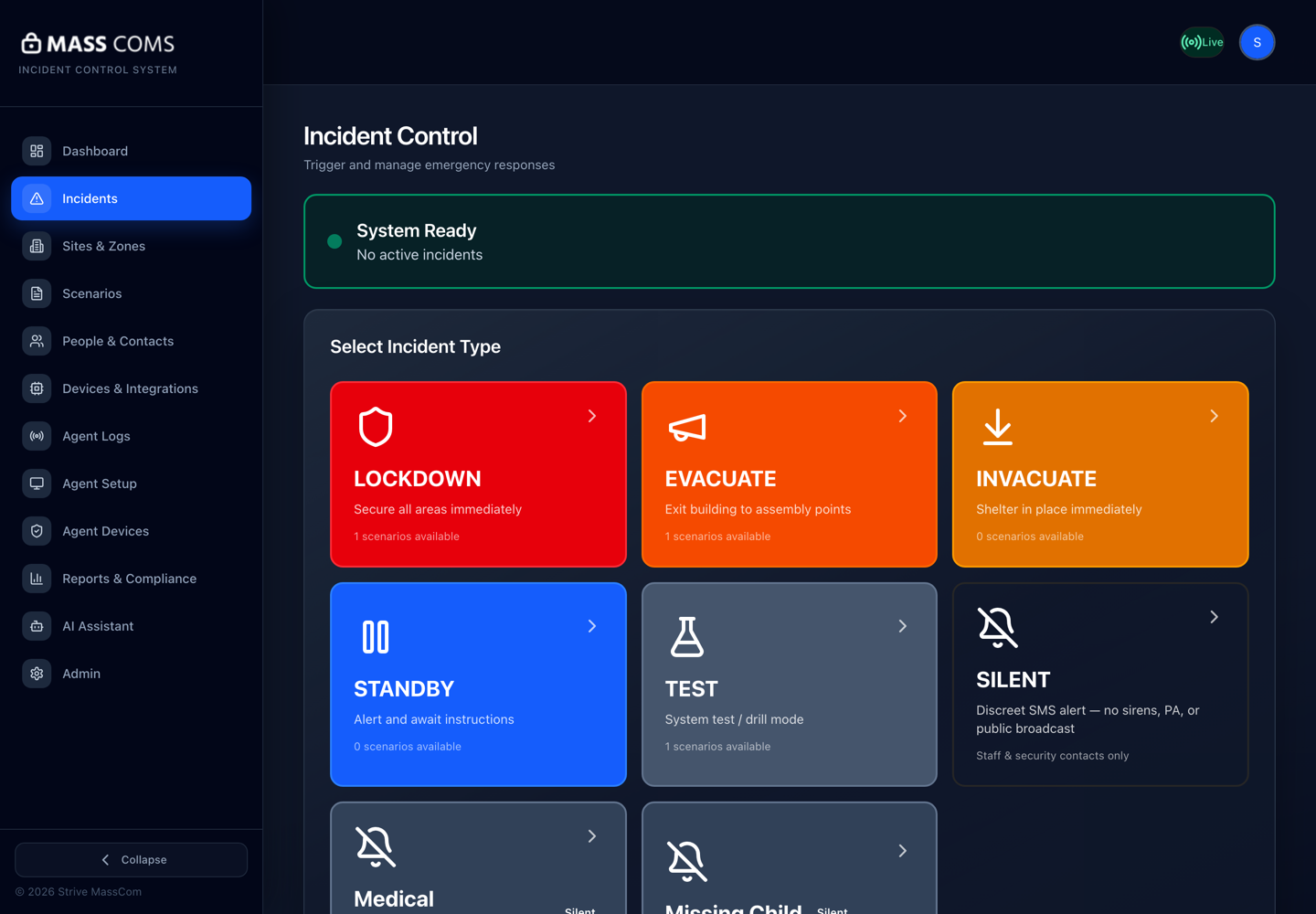
The six incident typesMassComs Incident Control showing LOCKDOWN, EVACUATE, INVACUATE, STANDBY, TEST and SILENT with their scenario counts. - 02
EVACUATE — exit building to assembly points
Leave the building by the nearest safe route and muster at the assembly point for your zone. This is the type that depends most heavily on floorplan quality — routes, exits and assembly points must all be correct.
If your floorplans are not verified, evacuate will still work as an alert, but the route guidance it shows may be wrong. Verify before you rely on it.
- 03
INVACUATE — shelter in place immediately
Move inside and stay there. Used for an external hazard — weather, a chemical release, an incident in the surrounding area — where the safest place is indoors.
Invacuation is often confused with lockdown. Lockdown secures against an internal threat; invacuation brings people in from outside. The difference matters to anyone currently on a field or in a car park.
- 04
STANDBY — alert and await instructions
Something is developing; do not act yet. Standby is the type that buys you time without committing to a movement instruction, and it is under-used.
Raising standby early and then escalating is almost always better than waiting until you are sure and then activating a full response. It also gets responders looking at their devices before it matters.
- 05
TEST — system test / drill mode
Exercises the full delivery path and is recorded as a drill rather than a real event. Use it for anything where surprise is not the objective.
TEST is a first-class type, not a debug flag. Its records count as drill evidence.
- 06
SILENT — discreet alert, no sirens, PA or public broadcast
Notifies configured security and police numbers by SMS and appears in the silent panic log, without any audible or visible response in the building.
The absence of a visible response is the feature. Use it when alerting the room would escalate the situation — an aggressive individual at reception, a safeguarding concern, a threat where the person must not know a call has been made.
Silent panic still works without configured numbers — the alert is raised and logged with a full audit trail — but nothing is texted to anyone. The panel says so plainly, and it is the difference between a record and a response.
- 07
How the type interacts with scenarios
Scenarios are created against a type, and only approved scenarios of the selected type are offered at activation. This is why a well-populated organisation has several approved scenarios per type — a lockdown for an internal threat reads very differently from a lockdown for a nearby police operation.
The scenario wizard offers five scenario types — Lockdown, Evacuation, Invacuation, Test / Drill and Custom. Custom is where everything else lives: medical emergencies, missing persons, safeguarding responses. A Custom scenario can be Broadcast or Silent, and approved Silent ones appear on the trigger page as their own violet Silent tiles, next to the six fixed types.
STANDBY has no scenario type of its own — it is triggered with default settings, which is what makes it the fast, low-commitment first move.
Good to know
Small details that prevent big confusion.
- Every type reaches every configured channel. What changes is the instruction, not the reach — except SILENT panic and Silent custom scenarios, which deliberately suppress audible and public channels.
- If you cannot decide between standby and a movement type, standby first. Escalation is easy; un-evacuating a building is not.
- Practise with TEST, not with real types. A drill run as LOCKDOWN teaches people that lockdown might not be real.
Was this guide clear?